How to Choose PET Acoustic Panels: A B2B Buyer’s Guide
PET acoustic panels have become the default sound-absorbing finish for offices, schools, hotels and retail interiors. They are light, safe to handle, easy to cut and available in dozens of colors. But for a contractor, distributor or fabricator buying by the container, “PET panel” covers a wide range of products. Two sheets that look identical on a sample table can behave very differently once they are routed, glued to a wall or tested by a fire inspector.
This guide walks through the specifications that actually matter when you source PET acoustic panels for B2B projects: what the material is, how density and thickness affect performance and fabrication, how to read sound absorption and fire test reports, and what to check before you place a bulk order.
What is a PET acoustic panel?
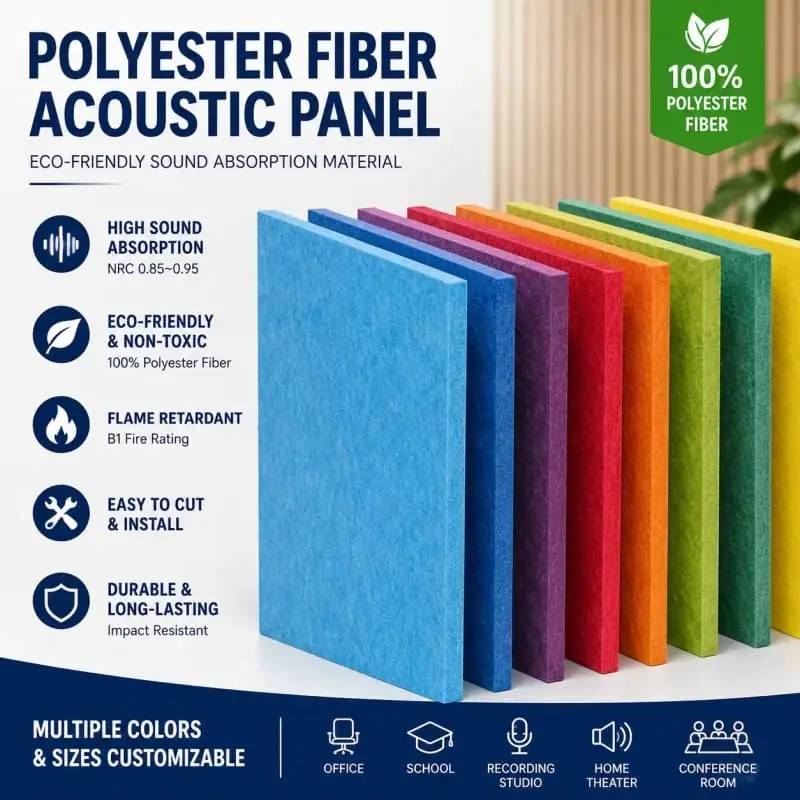
A PET acoustic panel is a non-woven board made from polyester (polyethylene terephthalate) fibers. The fibers are carded into a web, layered and thermally bonded under heat and pressure into a rigid, felt-like sheet. Many manufacturers use recycled PET fiber, often from post-consumer bottles, which is why the material is popular on green building projects.
Because the board is porous, sound waves entering it lose energy as friction inside the fiber network. That makes PET a sound absorber: it shortens reverberation time and reduces echo inside a room. Compared with traditional fabric-wrapped fiberglass, PET has no loose glass fibers, needs no fabric facing and can be cut with a utility knife or CNC router.
Absorption is not soundproofing
The most common misunderstanding in this category: PET panels improve how a room sounds, but they do not stop sound from passing through walls. Blocking noise between rooms (sound insulation) depends on mass, airtightness and decoupled construction. If a client’s complaint is “we can hear the meeting room next door”, PET wall panels alone will not solve it. If the complaint is “this room is echoey and conversations are hard to follow”, they are exactly the right tool. Getting this distinction right at the quotation stage prevents disappointed end users later.
Density: the specification that drives everything else
Density is usually given as weight per area (g/m²) or as weight per sheet for a given thickness. It affects four things buyers care about:
- Rigidity and flatness. Higher-density sheets stay flat over a full 1220 × 2440 mm span and resist denting in high-traffic areas.
- Machining quality. CNC routing, 45° V-grooving and 3D carving leave cleaner edges on denser boards. Low-density sheets can fuzz or tear at sharp corners.
- Surface durability. Corridors, classrooms and gyms benefit from a denser, harder face.
- Cost and freight. More fiber means more material cost and more weight per container.
As a reference, RAW Acoustic standard sheets range from a low-density 8 mm sheet (about 3 kg per sheet) through a standard 9 mm sheet (about 3.8 kg) to a high-density 9 mm sheet (about 5 kg). Same thickness, very different handling. When comparing quotations from different factories, always compare weight per sheet at the same thickness, not just the thickness itself.
Thickness: matching the sheet to the job
Thicker sheets generally absorb more sound, especially at lower frequencies, and give more depth for grooving and carving. Mounting also matters: leaving an air gap behind the panel can improve low-frequency absorption without changing the sheet. A practical way to think about thickness:
| Thickness | Typical uses | Buying notes |
|---|---|---|
| 8–9 mm | Wall cladding, pinned or adhered panels, office and classroom walls, partition facings | Most economical per m²; choose higher density if the sheet will be grooved or exposed to traffic |
| 12 mm | Feature walls, ceiling clouds, CNC-cut patterns, hospitality interiors | A balanced choice for fabricators who need depth for V-grooves |
| 15 mm and above | Hanging baffles, deep 3D carving, studios and spaces that need more absorption | Heavier per sheet; check freight weight and fixing method |
These are general guidelines, not acoustic design values. For performance-critical rooms, select thickness and mounting from the manufacturer’s tested absorption data, ideally with input from an acoustic consultant. RAW Acoustic produces standard thicknesses of 8, 9, 12 and 15 mm, with custom thickness from 8 to 25 mm for OEM orders. See the 12 mm and 15 mm standard sheets.
How to read sound absorption data
Sound absorption figures are only meaningful if you know how they were measured. When a supplier quotes an absorption rating, ask for the full test report and check three things.
1. The test method
Credible absorption data comes from a reverberation room test under ISO 354 or the North American equivalent, ASTM C423. Small “impedance tube” tests are useful in R&D but are not a substitute for a reverberation room result on a full-size specimen.
2. The single-number rating
- NRC (Noise Reduction Coefficient) is the average absorption at 250, 500, 1000 and 2000 Hz, rounded to the nearest 0.05. It is common in North American specifications.
- αw (weighted sound absorption coefficient) and the absorption classes A–E come from ISO 11654 and are standard in Europe, the Middle East and much of Asia.
3. The mounting condition
The same panel tested directly on a hard surface and tested with an air gap behind it will produce different numbers. A rating without the mounting type (and the thickness and density of the specimen) cannot be compared with another supplier’s figure. When a quote shows one impressive number for an entire product range, ask which thickness, density and mounting it belongs to.
Fire safety ratings by market
Interior finishes in commercial buildings must meet local fire codes, so the fire report often matters more to the approving authority than the acoustic report. The two references you will meet most often:
- ASTM E84 (US and many export markets): a tunnel test that reports a flame spread index and a smoke-developed index. Class A is the highest classification for interior finishes.
- EN 13501-1 (Europe and markets that follow European codes): classifies reaction to fire from A1 to F, with additional ratings for smoke (s1–s3) and flaming droplets (d0–d2).
RAW Acoustic sheets are made from flame-retardant polyester fiber and are rated ASTM E84 Class A and EN 13501-1 Class B-s1,d0. Whatever supplier you use, request the report itself, check that the tested product matches the thickness and density you are buying, and confirm the classification your local code requires for the specific application (for example, walls versus ceilings, or escape routes).
Health and sustainability
Architects and developers increasingly ask for material data on indoor air quality and recycled content. For PET panels, the useful questions are:
- Is the board formaldehyde-free, and what are its VOC emissions?
- What share of the fiber is recycled, and is the product itself recyclable at end of life?
- For self-adhesive sheets, what adhesive is used and is it low-VOC?
RAW Acoustic sheets use 100% recyclable flame-retardant polyester fiber, are formaldehyde-free and low-VOC, and our self-adhesive line uses a zero-VOC pressure-sensitive backing.
Plain sheets or self-adhesive?
Most factories offer PET raw sheets in two formats, and the right one depends on who will process and install them.
- Plain (unbacked) sheets are the choice for CNC fabricators, panel processors and anyone laminating, grooving, carving or cutting baffles. They are installed with spray adhesive, construction adhesive or mechanical fixings.
- Self-adhesive sheets come with a factory-applied peel-and-stick backing, so installers can mount panels directly on clean, smooth walls without separate glue. This is popular with contractors on fast-track fit-outs; RAW Acoustic’s Quick-Install self-adhesive sheets can cut job-site installation time by up to 50%.
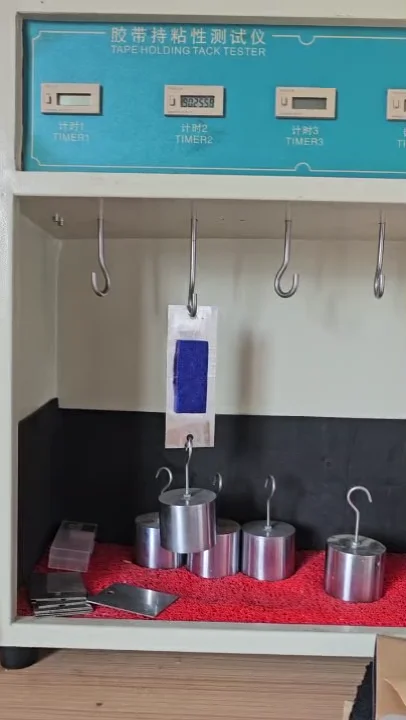
If you choose self-adhesive, ask the supplier about adhesive testing (tack and holding power), shelf life of the backing and the substrates it is suitable for. Surface preparation still matters: dust, fresh paint and uneven walls are the usual causes of adhesion failures.
Color consistency across batches
On large projects, panels are often delivered in several shipments or reordered months later. Color drift between batches is very visible on a feature wall. Before ordering, ask whether the factory dyes or coats in-house, how it controls batch-to-batch color, and whether it can hold a reference sample for your account.
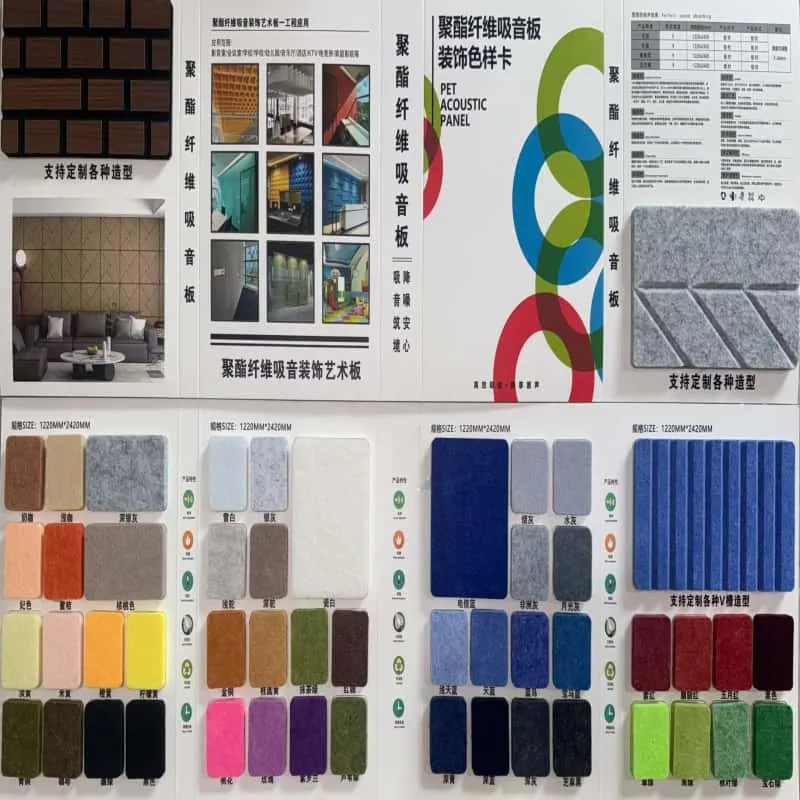
Screens never show felt colors accurately, so approve colors from physical swatches. RAW Acoustic offers 48 architectural colors with in-house coating capacity of over 100,000 m² per month.
Buying checklist for bulk orders
Before you confirm a container order, make sure you have answers to these questions:
- Sheet size and tolerance. Standard size is 1220 × 2440 mm (4 × 8 ft). Ask about thickness tolerance; RAW Acoustic works to ±0.3 mm.
- Weight per sheet at each thickness, so you can compare density between suppliers.
- Test reports for sound absorption (method, specimen and mounting) and fire (standard and classification), plus any quality certifications.
- Samples of the exact grade you will order, not just a color chip.
- Custom options such as custom sizes, density, thickness or branded sample kits if you are a distributor.
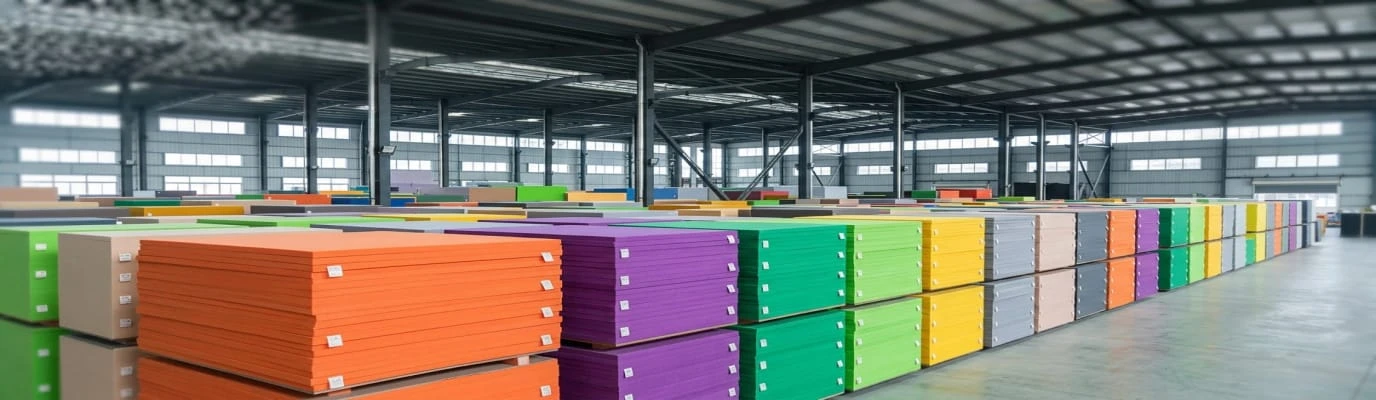
- Packing and shipping. LCL, 20′ GP or 40′ HQ, palletizing, edge protection and how sheets are interleaved to prevent marking.
- Lead time and payment terms, confirmed in writing on the proforma invoice.
Frequently asked questions
Are PET acoustic panels fire-rated?
Quality PET panels are made with flame-retardant fiber and tested to standards such as ASTM E84 or EN 13501-1. Ratings differ between products, so always check the report for the exact grade you buy.
Can PET panels be cut and machined?
Yes. They can be cut with a sharp knife, panel saw, laser or CNC router, and denser sheets give cleaner V-grooves and carved patterns.
Do PET panels block noise from neighboring rooms?
No. They absorb sound inside a room to reduce echo and reverberation. Blocking noise between rooms requires sound insulation in the wall or ceiling construction.
What thickness should I order?
8–9 mm suits most wall cladding, 12 mm is a common choice for grooved and feature panels, and 15 mm or more suits baffles, deep carving and rooms that need more absorption. Final selection should follow tested absorption data for your mounting method.
Have more questions? See our FAQs.
Source PET acoustic sheets direct from the factory
RAW Acoustic manufactures PET acoustic raw sheets in Guangdong, China for contractors, distributors, interior design firms and CNC fabricators worldwide. Compare grades on our products page, order a sample kit to check density and color in hand, or request a quote for your next project.